

What is the future of automation?
Advancing robotics beyond simpler tasks requires real-world demonstration – not more simulation. Physical AI refers to AI systems that act in the physical world, from humanoid robots and autonomous vehicles to industrial automation and healthcare.
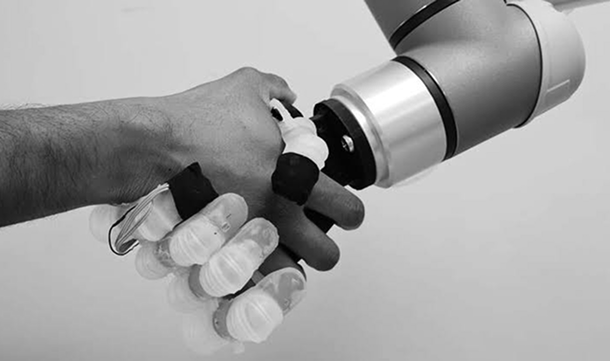
The control of robotic systems by a human operator remains a prevalent feature of technological advancement. This is referred to as teleoperation in robotics: the operator sends commands and receives sensor feedback in return, forming a continuous loop guiding the robot’s actions in real time.
Haply Robotics is a company that addresses this gap, providing a way to generate real-world motion data as robotic systems interact in 3D. Using bidirectional communication between humans and robots to translate motion into information, it does this via hardware, human touch, and force-feedback – Inverse3 (controller) and HARP (teleoperation platform).
Haply’s technology has been recognized with two CES 2026 Innovation Honoree Awards: one in the Artificial Intelligence category for HARP (its teleoperation platform), and one in the XR & Spatial Computing category for its MinVerse integration with Geomagic Freeform software.
Together, these two capabilities close the gap identified above: spatial interaction lets the operator feel what the robot encounters, while teleoperation preserves the human touch in the governance of automation. In doing so, they capture the intricacies of the 3D space that have been missing – the training data that feeds into the machine learning process.
Because every teleoperation workflow is spatially tracked, it creates a training data loop within the haptic system, putting Haply’s touch at the leading edge of robotics.
In a conversation with Ali Afzal on the Robot Builders Club podcast (July 24, 2026), Colin Gallacher (Haply co-founder) offers insight into where the technology is headed – the centrality of human touch to training physical AI.
The MedAcuity partnership – announced Oct. 15, 2025, with the regulatory-grade medical software company – aims to build surgical and diagnostic teleoperation using Haply’s interface technology. This aligns with the surging demand for more intuitive human-robot interfaces, particularly in telemedicine, defense, and industrial automation.
Investors turn their attention to autonomy software and robotics components.
According to PitchBook’s Q2 2026 Robotics & Physical AI Report, robotics and physical AI startups raised a record $18.6 billion across 450 deals in the quarter, with a 25.3% jump in deal value even as the number of deals fell.
Institutional capital is tracking tech companies pursuing the void.
Who has placed their bet?
Haply raised $11.75 million on Feb. 9, 2026, led by Sound Media Ventures and including the Amazon Industrial Innovation Fund, the Hanwha Asset Management Venture Fund, and VC fund Two Small Fish Ventures.
That’s some respite from the fear that automation completely displaces humanity – touch remains in the loop…